 Purlbed
Scarves & cowls · Beginner
Infinity scarf
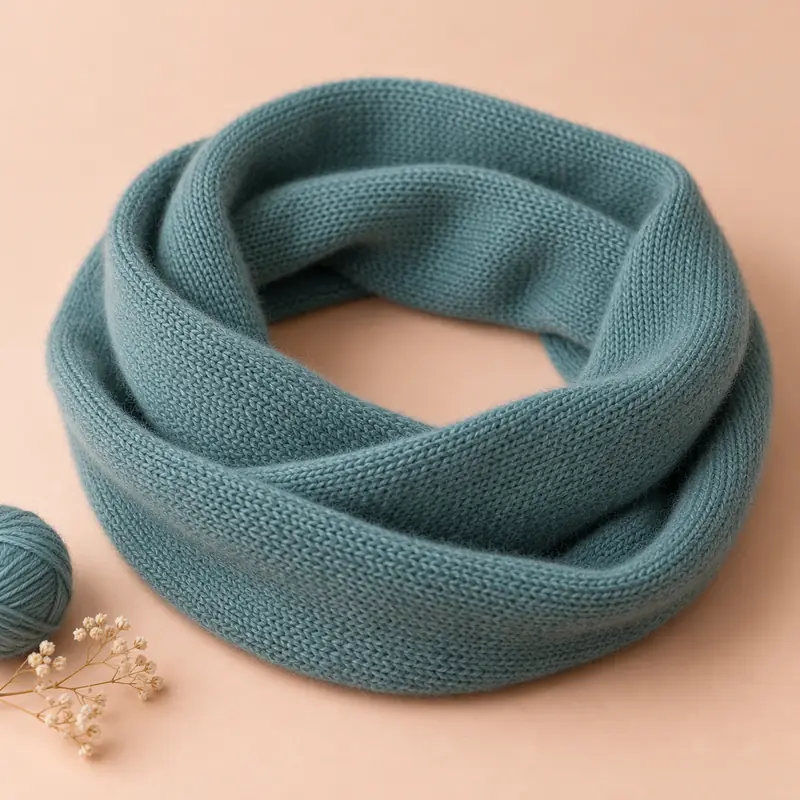
The same idea as the cowl, only longer: a strip as long as two turns round the neck, sewn end to end. It is a lot of rows, so a plain stocking stitch or a simple stripe makes it a relaxed evening project.
Which knitting machine do you have?
Not sure? Look for the model name on the carriage or the box and compare it with the examples.
Only machines that can knit this pattern are listed.
Which size?
How big are your stitches?
Start with your machine's needle spacing. For an exact fit, knit a small swatch and type in what you measure.
My own gauge (from a swatch)
How do I measure my gauge?
- Cast on 40 needles with waste yarn and knit a few rows. Change to the main yarn and choose a tension that gives a fabric you like (see the starting points below).
- Knit 60 rows. Tie a contrast thread to the 11th needle from each side at row 10 and row 50, so the marks are 20 needles and 40 rows apart.
- Knit a few rows of waste yarn and take the swatch off. Steam or wash it the way you will treat the finished piece, and let it rest flat for a few hours.
- Measure between the marks: stitches in 10 cm = 20 ÷ width in cm × 10, rows in 10 cm = 40 ÷ height in cm × 10. Type the two numbers into the gauge boxes above; that tension is your main tension (MT).
Add a little pattern? (you can skip this)
Pick a symbol, type a few letters, upload a picture or draw it stitch by stitch. Where your machine can, it knits the pattern from a punch card; otherwise you knit the piece plain and embroider the pattern on afterwards.
Before you start
- Yarn: A light, soft yarn so the loop is not heavy: 4-ply / fingering on a standard machine, DK on mid gauge, worsted on bulky. About 110 g in total for this size (an estimate from the area of the pieces; buy a little more).
- Also: Tapestry needle, Waste yarn (single bed)
- Adult · Single bed, punch card · Gauge (stocking stitch, after steaming): 30 sts × 40 rows
✓ Checked by the virtual test knit
Start knitting
All steps, charts, sizes and checks (for printing)
Virtual test knit
✓ Virtual test knit passedEvery row of every piece on this page has just been knitted on a model of your machine, for the size, machine and gauge you chose. The model follows each needle's loops through transfers, held needles, hems and cast-offs, then measures the finished pieces.
560 rows and 36,960 stitches knitted, 0 stitches transferred, 0 held-needle passes: no dropped stitch, no hole, no lost loop, every stitch cast off or secured at the end.
| Measurement | Should be | Simulated |
|---|---|---|
| Height | 21–23 cm | ✓ 22 cm |
| Circumference (before sewing) | 137–143 cm | ✓ 140 cm |
| Rows end where they started | 0–0 rows | ✓ 0 rows |
The simulation checks the instructions and the arithmetic. Yarn, tension and blocking still differ from knitter to knitter, so knit the gauge swatch first and type in your own numbers. Knitted one? We would love a photo: support@purlbed.com.
Adult · Single bed, punch card · Gauge (stocking stitch, after steaming): 30 sts × 40 rows
Sizes
| Measurement | Adult |
|---|---|
| Circumference (once sewn) | 140 cm |
| Height | 22 cm |
You will need
Yarn: A light, soft yarn so the loop is not heavy: 4-ply / fingering on a standard machine, DK on mid gauge, worsted on bulky.
About 110 g in total for this size (an estimate from the area of the pieces; buy a little more).
Also: Tapestry needle, Waste yarn (single bed)
Gauge swatch first
- Cast on 40 needles with waste yarn and knit a few rows. Change to the main yarn and choose a tension that gives a fabric you like (see the starting points below).
- Knit 60 rows. Tie a contrast thread to the 11th needle from each side at row 10 and row 50, so the marks are 20 needles and 40 rows apart.
- Knit a few rows of waste yarn and take the swatch off. Steam or wash it the way you will treat the finished piece, and let it rest flat for a few hours.
- Measure between the marks: stitches in 10 cm = 20 ÷ width in cm × 10, rows in 10 cm = 40 ÷ height in cm × 10. Type the two numbers into the gauge boxes above; that tension is your main tension (MT).
Pieces
Strip
Cast on 66 sts, 560 rows. Flat size about 22 × 140 cm.
Row by row
- Bring 66 needles into work (L33 to R33) and cast on in the main yarn with an e-wrap (closed edge). Set RC to 000.
- Knit 560 rows at MT (RC 560).
- Cast off loosely with the latch tool (or knit a few rows of waste yarn and cast off by hand).
Needle notation
Step 1 at the bottom; only the needles around the changes are shown.
Row sequence (1)
| Rows | What the carriage knits | Tension |
|---|---|---|
| 1–560 | Stocking stitch | MT |
Finishing
- Weave in the ends and steam lightly.
- Bring the two short ends together, right sides together, and sew them with mattress stitch. Turn the ring right side out.
Notes and changes
- Twist the strip once before you sew the ends and the ring becomes a Möbius: it sits flatter on the shoulders and the two sides show evenly.
- The circumference is a starting value from common loop scarves: 130–150 cm wraps twice. Change it in the size boxes.
- Knit in two or three sessions if your yarn runs out: join a new ball at the start of a row, never in the middle.
What the words mean
- Short rows (引返)
- knitting only some of the needles for a few rows while the others wait. The middle grows taller than the sides, which makes a cup: that is how the heel and toe of a sock get their curve.
- Hold
- the needle position for short rows: a needle pushed all the way forward keeps its stitch and does not knit while the carriage is set to hold.
- Turned hem
- a neat double edge: knit a strip, then fold it up and hang its first row back on the needles, so the edge is a fold instead of a raw cast-on.
- 1×1 rib
- one stitch on the main bed, one on the ribber, side by side: the stretchy edge of socks, cuffs and hat brims. Needs a ribber or a double bed.
- Decrease / increase
- making the piece one stitch narrower or wider at the edge. Fully fashioned means moving the 2 edge stitches in (or out) with a transfer tool, so the edge stays smooth for sewing.
- Transfer tool
- the small hook (1, 2 or 3 prongs) that lifts stitches off needles and puts them on others.
- Waste yarn
- a few rows in a spare colour knitted before or after the piece and pulled out later, leaving open loops to hang back or sew.
- MT (main tension)
- the tension dial number of your gauge swatch. MT−1 is one number tighter, MT+2 two numbers looser.
- RC (row counter)
- the counter on the carriage. Set it to 000 after casting on; every step says what it should read when the step is done.
- L10 / R10
- needle numbers, counted outwards from the middle (0) of the needle bed.
- Mattress stitch
- the usual way to sew knitted pieces together: you catch the bar between the first two stitches on each side, so the seam disappears.
- Duplicate stitch
- embroidery that follows a knitted stitch's V shape with a needle and a second colour, so the pattern looks knitted in.
purlbed.com/templates/infinity-scarf/ · Virtual test knit passed
Suits these machines
- Single bed, punch card
- Single bed, electronic
- Single bed, no patterning
- Single bed (punch card) + ribber
- Single bed (electronic) + ribber
- Double bed with pushers (Passap type)
- Double-bed hand flat (V-bed)
Techniques used
More templates
- Beanie
- Fold-up ribbed hat
- Slouchy hat
- Beret
- Earflap hat
- Baby bonnet
- Scarf
- Cowl
- Triangle scarf
- Mittens
- Fingerless mitts
- Newborn scratch mittens
- Wrist warmers
- Arm warmers
- Socks
- Ankle socks
- Knee-high socks
- Baby socks
- Christmas stocking
- Baby vest
- Leg warmers
- Boot cuffs
- Tote bag
- Drawstring bag
- Phone pouch
- Headband
- Cup cosy
- Baby blanket
- Doll sweater
- Teddy bear scarf and hat