 Purlbed
Lifted stitches › Lifts
Charted lift placement (blocks, diamonds, conceal-and-reveal)
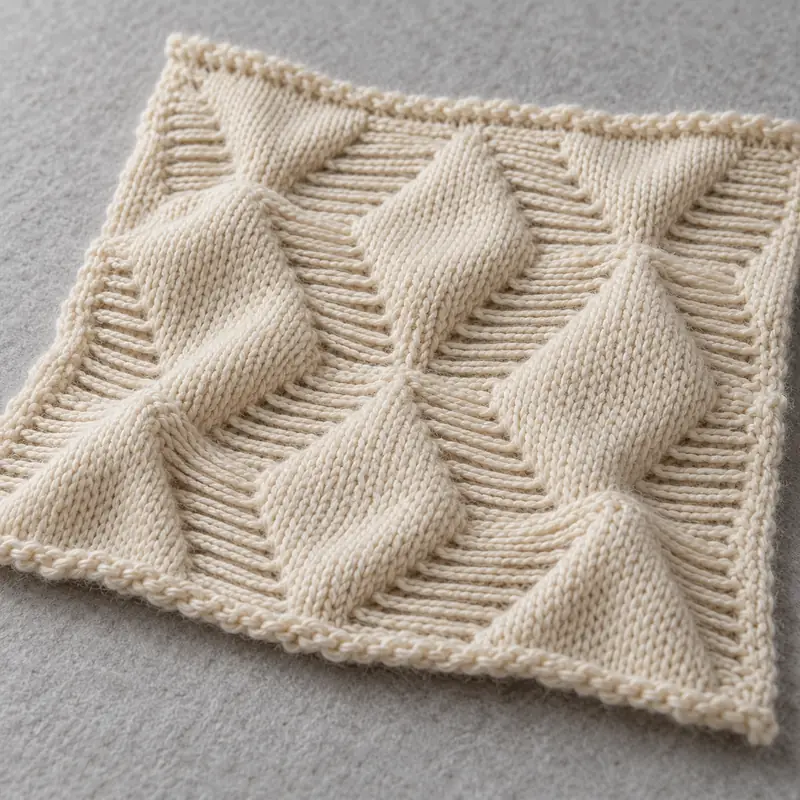
Purl face: crisp geometric motif (diamond, blocks) drawn by lifted strands. Knit face: soft undulating gathers that follow the motif; colours of alternate stripes peek out where fabric balloons ("conceal and reveal").
- Single bed
Machine types that can knit it
Demo swatch
Drawn for: Single bed, punch cardApproximate preview worked out from the bed chart, not a photo.
Steps
- Draw lift chart: one row of chart = one stripe.
- Knit stripe of R rows.
- Lift the marked needles from the last row of the previous colour.
- Change colour, repeat.
- For wider fabric, repeat motif centred on 0.
The full card
- What it looks like
- Purl face: crisp geometric motif (diamond, blocks) drawn by lifted strands. Knit face: soft undulating gathers that follow the motif; colours of alternate stripes peek out where fabric balloons ("conceal and reveal").
- How it behaves
- Wavy relief, medium; geometric on back, organic on front.
- How it works
- Same as honeycomb but lift positions follow a designed chart per stripe; clusters of adjacent lifts (blocks) give more form than scattered single lifts.
- Machines
- Single bed; squared paper chart; transfer tools.
- Parameters
- motif width W (12–50 needles), lift block size 2–10 needles, R = 6–12 rows per stripe (bigger R in the ripple yarn exaggerates waves); centre repeat on L1–R1.
- Steps
- 1) Draw lift chart: one row of chart = one stripe. 2) Knit stripe of R rows. 3) Lift the marked needles from the last row of the previous colour. 4) Change colour, repeat. 5) For wider fabric, repeat motif centred on 0.
- Charting
- Band-per-stripe chart, greyscale per yarn, marked cells = lift. Note: book charts are drawn as seen from the purl face (knitter's view), i.e. mirrored relative to the knit-face photo.
- Limits and common problems
- Sparse lifts over large areas dilute the effect; organic/hand-decided lifts give softer, less ordered texture (document positions if repeatability matters).
- Combines with
- elastic/shrinking yarn for the ripple stripes; multicolour stripes.
- Pieces and assembly
- Motif can be confined to a panel (e.g. a key top) with plain jersey borders for seaming.
Written in our own words from machine manuals, knitting references and swatching. Knit a test swatch before a whole piece.