 Purlbed
Tuck and slip › Slip
Two-colour slip / mosaic & maze
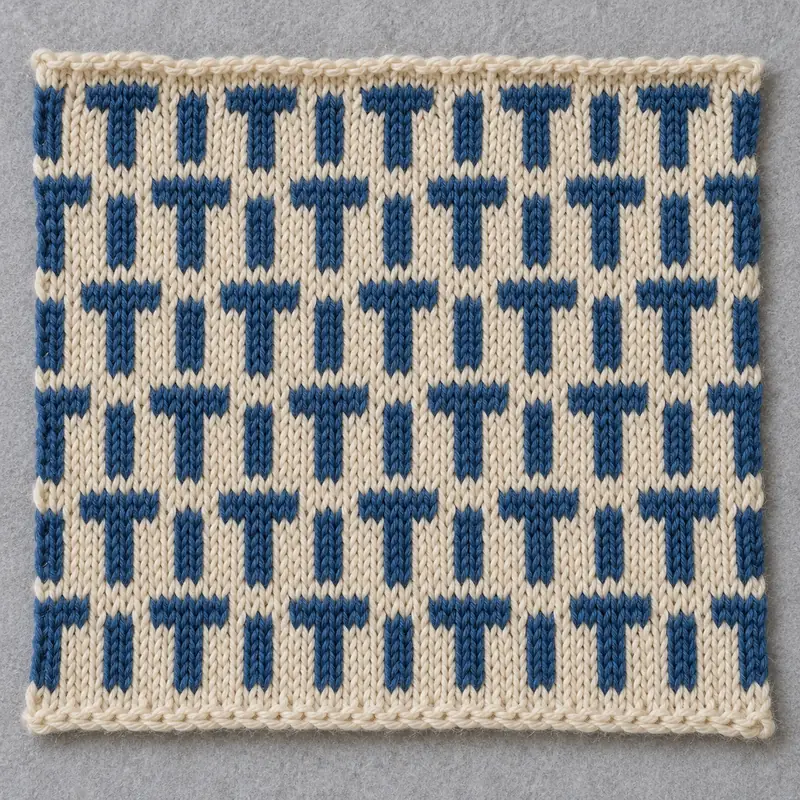
Crisp geometric two-colour patterns (mazes, Greek keys, checks) on the knit side, built from 2-row stripes where slipped stitches carry colour vertically. Lines are horizontal stripes plus vertical "columns" of elongated stitches. Edges are sharper than in tuck. PART buttons with K.C.
- Single bed
- Needle selection
Machine types that can knit it
Demo swatch
Drawn for: Single bed, punch cardApproximate preview worked out from the bed chart, not a photo.
The full card
- What it looks like
- Crisp geometric two-colour patterns (mazes, Greek keys, checks) on the knit side, built from 2-row stripes where slipped stitches carry colour vertically. Lines are horizontal stripes plus vertical "columns" of elongated stitches. Edges are sharper than in tuck.
- How it behaves
- Firm, narrow and dense; less stretchy than Fair Isle. It can bias or ripple when the number of slipped needles varies row to row (unbalanced).
- How it works
- PART buttons with K.C. Yarn in feeder A changes every 2 rows. Each colour knits on punched needles and slips the blanks, so the previous colour's stitches show through.
- Machines
- KH-821 yes. Colour changer optional.
- Parameters
- Colour change every 2 rows. Slipped runs ≤ 2 adjacent (mosaic rule). One square of design ≈ 1 stitch × 2 rows; 2 rows ≈ 1 stitch width in scale.
- Steps
- Same as tuck-two-colour, but with PART buttons pressed instead of TUCK. - Odd rows (mostly knitting) may have any number of holes. - Even rows have mostly single blanks; no more than 2 blanks side by side. - Vertical lines start and end on odd rows and span an odd number of rows. - Total height must be even (colour returns to the same side). - Without elongation, every row pair is punched separately on the card.
- Charting
- Design chart in two colours (each square = 1 st × 2 rows), then convert to a card chart where each design row becomes 2 identical card rows (■ = knit, □ = slip).
- Limits and common problems
- Doubling rows by hand doubles card length (the KH-821 has no elongation). Unbalanced rows cause biasing. Wrong row parity causes colour errors.
- Combines with
- two-colour tuck, stripes.
Written in our own words from machine manuals, knitting references and swatching. Knit a test swatch before a whole piece.